
MPC wallet vs seed phrase architectures represent the defining security paradigm split within modern digital asset custody, forcing investors to re-evaluate how they defend their on-chain wealth. Historically, self-custody relied on a single cryptographic master key translated into a human-readable string of twelve or twenty-four random words.
- Recover Lost Private Key Failures Safely with Cryptographic Methods
- How to Secure MetaMask Wallet Extensions: 5 Critical Hardware Isolation Workflows
- 5 Best Account Abstraction Wallet Solutions Rewriting Web3 Usability
- What is Crypto Wallet Browser Security? 3 Rules to Block Drainers
- 5 Best Crypto Hardware Wallets Classified by Custody Architecture
As automated wallet drainers and social-engineering phishing campaigns evolve, relying on a single physical backup has exposed massive operational vulnerabilities. The rapid rise of Multi-Party Computation (MPC) introduces a mathematically distributed alternative, aiming to eliminate standard single points of failure entirely from the web3 asset ecosystem.
Related: MPC Wallet vs Seed Phrase: The Ultimate 2026 Crypto Security Battle
Deconstructing the Cryptographic Mechanics of MPC Wallet vs Seed Phrase Setups
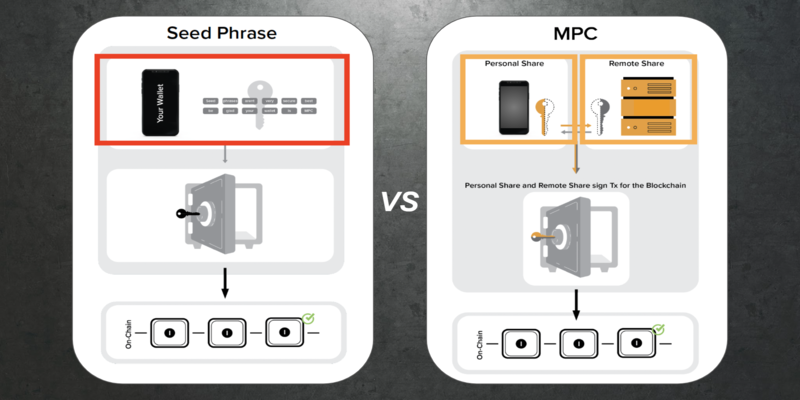
Understanding the separation between these two storage philosophies requires analyzing how a transaction is digitally signed. In a traditional wallet setup, a standard recovery mnemonic acts as the root source from which all public and private keys are mathematically derived.
When a transaction needs to be pushed to the blockchain network, the software requires the complete private key to reside in the memory of a single device to sign the payload. If that device is compromised by local malware or spyware, the entire underlying portfolio can be immediately siphoned away.
Multi-Party Computation completely re-engineers this sequence by ensuring that a single, complete private key never exists at any point in time.
- The master key is mathematically broken down into independent mathematical secrets known as key shares.
- These shares are distributed across isolated computing environments, such as a user’s mobile smartphone, an encrypted cloud storage layer, and the infrastructure servers of a wallet provider.
- During a transaction request, the distinct parties perform a decentralized computation to generate a valid network signature without ever revealing or reassembling their individual shares.
Read More : What is an NFC Hardware Wallet? A 3-Step Setup Guide
This decentralized verification method is highly valued across modern, data-sensitive industries. For example, high-volume digital platforms like đá gà tonhon rely on heavily distributed server clusters to settle transactions and execute streaming data safely without letting a singular database node handle vulnerable core details. In decentralized web applications, using a seedless framework provides a parallel security layer, ensuring that no lone server breach compromises user assets.
Operational Resilience: Comparing Vulnerabilities to Phishing and Key Management Failures
When reviewing daily usage patterns, the practical vulnerabilities of traditional backups become incredibly clear. Millions of dollars are lost annually because users are tricked into manually entering their private mnemonics into fake customer support interfaces or copycat decentralised applications.
- Traditional mnemonics are entirely static, meaning that once a third party catches a glimpse of the written sequence, control is permanently lost.
- Physical paper backups are fragile, highly susceptible to water damage, accidental disposal, or basic misplacement.
- Hardware wallets mitigate online exposure but still introduce heavy user stress during the initial physical backup process.
MPC architectures neutralize typical phishing playbooks by replacing human-memorized strings with robust Web2-style multi-factor authentication and local biometrics. Since there is no physical sequence of words to write down, a malicious actor cannot trick an investor into revealing a master code.
This infrastructure framework is covered extensively across CryptoInsight, where enterprise cybersecurity analysts emphasize that breaking up a secret key drastically raises the difficulty bar for attackers, who would have to simultaneously hack entirely different computing platforms to extract enough data shares to authorize an illicit asset transfer.
The Modern Trade-Off: Weighing Pure Self-Sovereignty Against Fail-Safe Account Recovery
Choosing between these advanced storage tools ultimately forces an investor to balance pure ideological decentralization against practical daily recovery options. Traditional setups provide absolute self-sovereignty; the owner answers to no one, operates completely independent of any company infrastructure, and can restore their assets using any compatible wallet client globally.
Read More : Ultimate Air Gapped Crypto Wallet Guide: How to Setup 100% Offline Storage
However, this absolute independence leaves zero room for human error, as losing the master paper backup means the digital assets are permanently trapped in the blockchain ledger.
Seedless options reshape the onboarding experience by offering intuitive, multi-layered social and biometric recovery paths. If an operator smashes their phone, access can be rebuilt by combining an encrypted cloud share with secondary identity verifications managed by the software provider.
High-stakes entertainment networks and global processing channels, such as đá gà tonhon, implement similar robust multi-factor validation flows to ensure that authentic participants can easily reclaim account access while automatically blocking malicious account takeover attempts. By translating this multi-device safety architecture to Web3, users retain complete decentralized control over their capital without carrying the constant stress of safeguarding a fragile paper backup.
Conclusion
The intense MPC wallet vs seed phrase debate underscores a broader shift toward practical, institutional-grade security structures designed for everyday retail environments. While traditional mnemonic words will always appeal to purists who demand isolated self-sovereignty, the architecture places an unforgiving burden of perfection on the individual.
By utilizing mathematical Multi-Party Computation to fragment key custody across independent boundaries, seedless wallets successfully eliminate catastrophic single points of failure without forcing users into third-party custodial pools. For the vast majority of active investors looking to navigate decentralized finance confidently, adopting a distributed security layer provides the healthiest, most resilient shield against the complex threats of the modern web.
Source: https://cryptoinsight.news
Category: Security & Wallets